Market outlook

The global electric vehicle market is experiencing robust and sustained growth, driven by technological innovation, supportive government policy, expanding model availability, and increasing consumer and commercial adoption.
EVs are shifting from early adoption to mainstream market penetration, with rising demand from fleet operators, logistics services, and private buyers. The expansion of charging infrastructure, improvements in battery performance, and regulatory commitments to net-zero emissions are further accelerating the transition to electric mobility.
Global Market Overview
In 2025, global EV sales exceeded 20 million units, a ~20 % year-on-year increase from 2024, with EVs accounting for roughly 24 % of all new vehicle sales worldwide. China remains the dominant market, contributing the largest share of global EV sales, followed by Europe and emerging contributions from North America and Asia-Pacific regions.
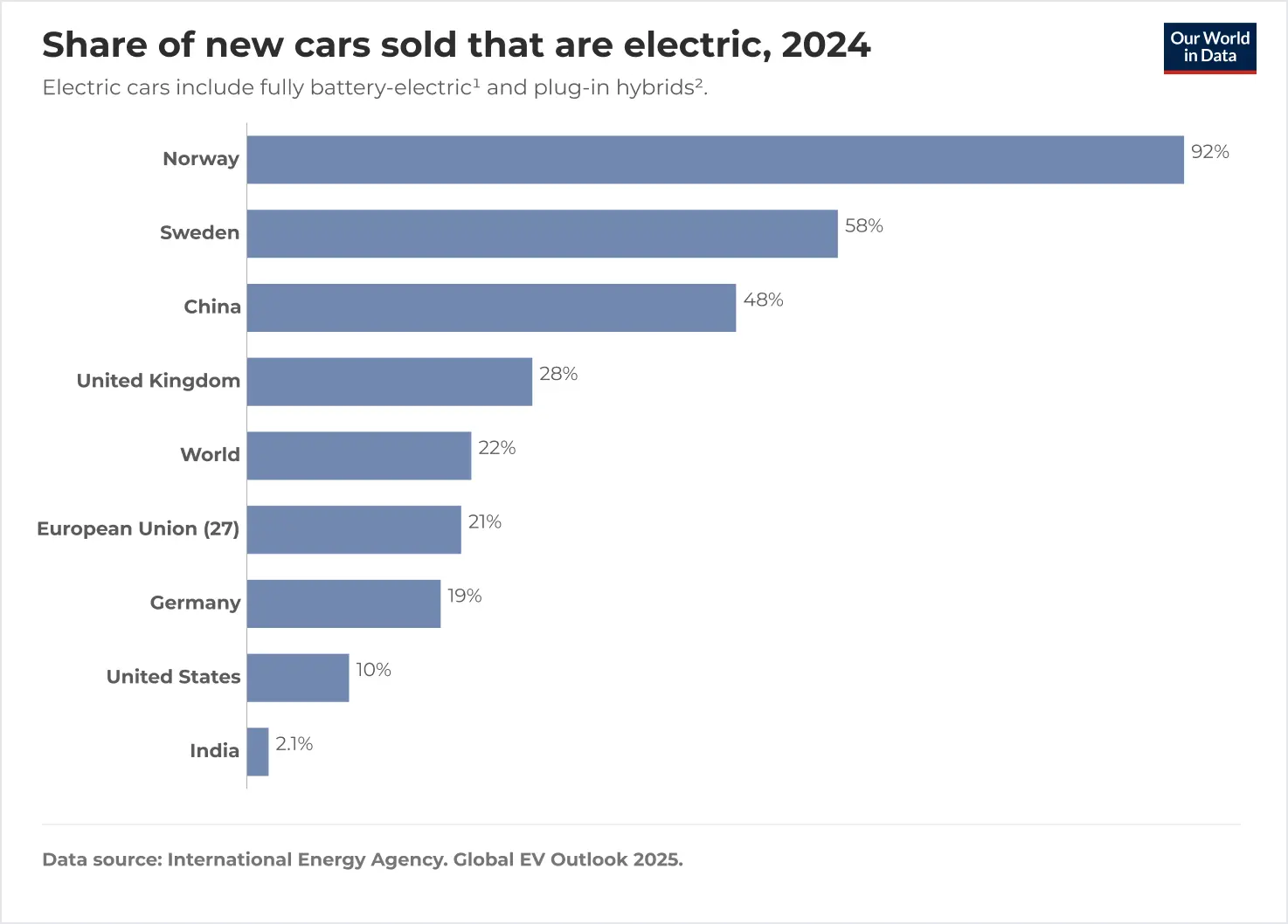
Industry projections show continued expansion in 2026, with global EV sales expected to surpass ≈21 million units, representing around 25 % of new light-vehicle sales. By 2030, global EV sales could exceed 40 million units annually, capturing more than 40 % market share as electrification accelerates across passenger, commercial, and heavy-duty segments.
Key global drivers include:
- A growing EV model portfolio with over 1,000 models expected by 2026.
- Declining battery costs improving affordability and consumer choice.
- Investment in public and private charging infrastructure scaling rapidly to meet demand.
- Increased electrification of light- and heavy-duty commercial fleets.
European Market Dynamics

Europe continues to lead global EV growth, driven by stringent CO₂
emissions standards, government incentives, and expanding
infrastructure networks.
In 2025, European EV sales climbed more than 30 % year-on-year,
with EVs reaching an estimated 4.3 million registrations,
outpacing overall market growth. Public charging infrastructure in the region grew strongly as
well, with over 1 million public charge points installed by the
end of 2025.
Independent forecasts indicate continued momentum in 2026, with
European EV sales projected to reach ≈5 million units, supported
by expanded model offerings, fleet electrification mandates, and
strategic policy support across major markets such as Germany,
France, and the UK.
European market characteristics include:
- Rapid growth in battery-electric vehicle (BEV) adoption.
- Expansion of ultra-fast charging corridors and depot infrastructure.
- Corporate and public fleet electrification commitments.
- Policies like the EU’s “Fit for 55” that aim to reduce emissions and accelerate ZEV transitions.
UK’s Market Overview

The UK has emerged as a dynamic and high-growth EV market
within Europe. By late 2025, EV registrations climbed
strongly, with the share of battery and plug-in hybrid EVs
combined reaching ≈38 % of new car sales, driven by strong
model availability, ZEV mandates, and expanding infrastructure
deployment.
Leading industry forecasts suggest that in 2026, UK EV
registrations could reach ~580,000 units,
representing approximately 29 % of all new vehicle sales, up
significantly from 2025 figures. Electric light commercial
vehicle (ELCV) sales are also anticipated to grow by ~50 %
year-on-year, highlighting strong fleet electrification
momentum.
The UK market is supported by:
- Rapid expansion of public and private charging infrastructure.
- Strong fleet and commercial electrification demand.
- Ongoing growth in consumer acceptance of EVs.
- Innovation in EV-related services and software.
Why London?

London stands at the centre of the European EV ecosystem, supported by world-class infrastructure, robust regulatory frameworks, and strategic positioning within the global automotive and mobility industries.
Key reasons London is a prime EV hub:
Infrastructure Leadership:
The city has one of the most comprehensive charging networks in Europe, complemented by rapid expansion plans for both public and private charging points.
Government Support:
The UK government’s commitment to net-zero emissions,
ambitious ZEV mandates, and targeted incentives bolster
ecosystem growth.
Innovation and Investment:
London is home to numerous EV startups, technology ventures, and funding institutions that drive innovation in battery tech, smart charging, and connected mobility.
Strategic Access:
As a global financial centre, London provides unmatched
access to capital, international markets, and cross-sector
partnerships.
Over the years, the London EV Show has become one of the most influential events in the global EV calendar, offering a collaborative platform for stakeholders to showcase innovative technologies, explore policy developments, and forge strategic partnerships. As the EV market continues accelerating, London’s role in shaping the future of sustainable transportation is set to become even more significant.
